DMcFadden
Puritanboard Commissioner
One could just as easily show instances where the KJV translates the same Greek word in harmony Gospel accounts with different English words, leading the reader to think that the underlying Greek is more different than it actually is.
A helpful exercise would be to read the translator's preface to the KJV.
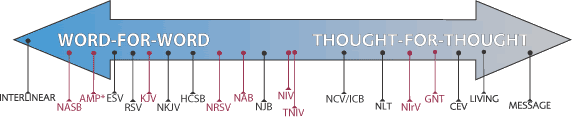
NONE of the formal correspondence style translations is perfect. However, the KJV, NKJV, ESV, HCSB, and NASB, despite their differences over which text to use or how to replicate into English the Hebrew and Greek originals, come mighty close to being "word for word" translations in a way that the NIV, TNIV, NLT, CEV, TEV, JB, LB, Message, etc. will NEVER be.
Now in a "downsizing" mode in preparation for an eventual move to Indiana to be near children and grandchildren, Jeanette and I have been eliminating clutter in our lives. Accordingly, it has been my goal to keep one exemplar in fine leather (R.L. Allan if possible) of each of the solid formal correspondence transations: KJV, NKJV, ESV, and HCSB (NASB is soooo wooden to my ears that using it on the computer is good enough for me, can't imagine carrying it to church) and of my favorite study Bibles (ESV Study Bible, MacArthur ESV, and Reformation Study Bible). The rest of them were put back into "circulation" and saved me shelf space on my desk.
A helpful exercise would be to read the translator's preface to the KJV.
[emphasis mine]Another things we think good to admonish thee of (gentle Reader) that we have not tied ourselves to an uniformity of phrasing, or to an identity of words, as some peradventure would wish that we had done, because they observe, that some learned men somewhere, have been as exact as they could that way. Truly, that we might not vary from the sense of that which we had translated before, if the word signified that same in both places (for there be some words that be not the same sense everywhere) we were especially careful, and made a conscience, according to our duty. But, that we should express the same notion in the same particular word; as for example, if we translate the Hebrew or Greek word once by PURPOSE, never to call it INTENT; if one where JOURNEYING, never TRAVELING; if one where THINK, never SUPPOSE; if one where PAIN, never ACHE; if one where JOY, never GLADNESS, etc. Thus to mince the matter, we thought to savour more of curiosity than wisdom, and that rather it would breed scorn in the Atheist, than bring profit to the godly Reader. For is the kingdom of God to become words or syllables? why should we be in bondage to them if we may be free, use one precisely when we may use another no less fit, as commodiously?
NONE of the formal correspondence style translations is perfect. However, the KJV, NKJV, ESV, HCSB, and NASB, despite their differences over which text to use or how to replicate into English the Hebrew and Greek originals, come mighty close to being "word for word" translations in a way that the NIV, TNIV, NLT, CEV, TEV, JB, LB, Message, etc. will NEVER be.
Now in a "downsizing" mode in preparation for an eventual move to Indiana to be near children and grandchildren, Jeanette and I have been eliminating clutter in our lives. Accordingly, it has been my goal to keep one exemplar in fine leather (R.L. Allan if possible) of each of the solid formal correspondence transations: KJV, NKJV, ESV, and HCSB (NASB is soooo wooden to my ears that using it on the computer is good enough for me, can't imagine carrying it to church) and of my favorite study Bibles (ESV Study Bible, MacArthur ESV, and Reformation Study Bible). The rest of them were put back into "circulation" and saved me shelf space on my desk.